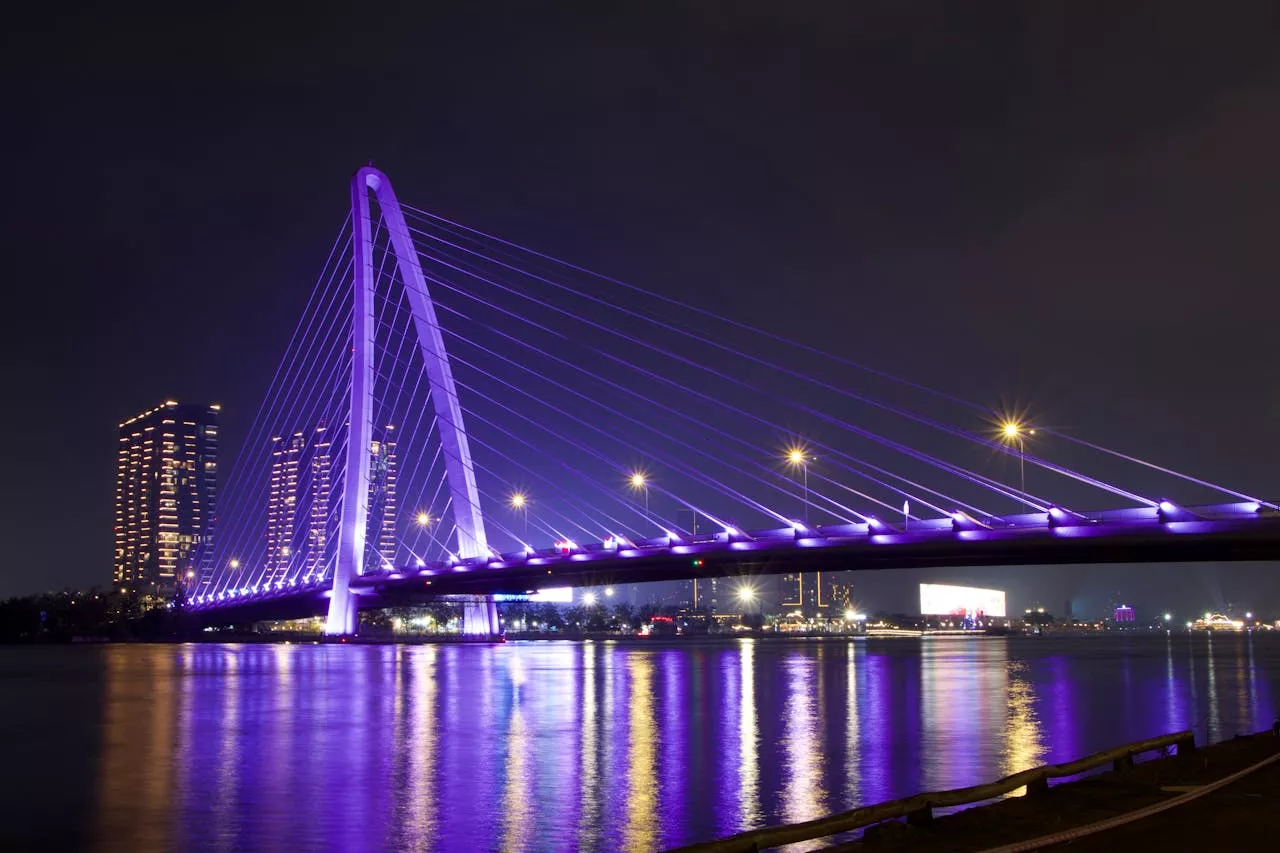
Taiwan marked a historic achievement in infrastructure and engineering with the inauguration of the Danjiang Bridge on May 9, ahead of its official opening to traffic on May 12. Recognized as the world’s longest single-mast asymmetric cable-stayed bridge, the project represents the successful completion of nearly 30 years of planning, design, and construction efforts.
The inauguration ceremony took place in New Taipei City and was attended by several senior government leaders, including President Lai Ching-te, Premier Cho Jung-tai, Minister of Transportation and Communications Chen Shih-kai, and New Taipei Mayor Hou Yu-ih. During the event, officials celebrated the bridge not only as a major engineering accomplishment but also as a transformative transportation link connecting the Tamsui and Bali districts across the mouth of the Tamsui River.
Speaking at the ceremony, President Lai described the Danjiang Bridge as a symbol of national pride and a project that demonstrates Taiwan’s engineering capabilities on the global stage. He emphasized that the bridge would become one of Taiwan’s most recognizable landmarks and an international showcase of the country’s innovation and determination.
According to Lai, the completion of the bridge reflects Taiwan’s ability to overcome challenges through collaboration and unity. He expressed hope that citizens across the country would see the project as evidence of the international respect Taiwan has earned through its technological and engineering achievements.
The Danjiang Bridge is especially notable for its architectural design. The structure was designed by the late Zaha Hadid, the internationally renowned architect and Pritzker Prize winner often referred to as the “Queen of Curves.” Known for her futuristic and fluid architectural concepts, Hadid envisioned the bridge as both a functional transportation route and a visually striking landmark.
Stretching nearly one kilometer across the Tamsui River estuary in northern Taiwan, the bridge features a single curved mast that was inspired by the graceful movements of dancers from Taiwan’s famous Cloud Gate Dance Theatre. The elegant design blends engineering precision with artistic expression, creating a bridge that stands out as both infrastructure and public art.
The global architectural community has already recognized the importance of the project. International media outlet CNN previously named the Danjiang Bridge among the 11 architecture projects expected to shape the world in 2025. The recognition has further elevated Taiwan’s profile in the fields of architecture, construction, and infrastructure development.
Beyond its striking appearance, the bridge is expected to deliver major transportation and economic benefits for northern Taiwan. Authorities believe it will significantly reduce traffic congestion around the heavily used Guandu Bridge, which has long served as one of the primary routes connecting the region.
The new crossing will also improve travel efficiency between New Taipei City and Taiwan Taoyuan International Airport, making transportation faster and more convenient for residents, businesses, and tourists. Officials estimate that once the bridge opens to traffic, travel between Tamsui and Bali will be shortened by approximately 15 kilometers.
In addition, commuters are expected to save nearly 25 minutes in travel time, while traffic volumes on surrounding roads could decrease by as much as 30 percent. These improvements are anticipated to strengthen regional connectivity, support economic activity, and improve overall transportation conditions for thousands of daily travelers.
Despite the successful completion of the project, the journey to build the Danjiang Bridge was far from easy. The bridge was first proposed in 1998, but the development process encountered numerous delays over the years. Environmental impact assessments, design revisions, and technical challenges slowed progress significantly, pushing the project timeline far beyond its original expectations.
The project also struggled through multiple failed tender processes before construction finally commenced in 2019. Even after work began, engineers faced several major obstacles during construction. Teams had to address underwater leaks, difficult riverbed conditions, and strong winds near the river estuary, all of which complicated the building process.
Through advanced engineering techniques and persistent collaboration between government agencies, designers, and construction teams, the project was eventually brought to completion. Officials now view the Danjiang Bridge as a testament to Taiwan’s resilience, technical expertise, and commitment to modern infrastructure development.
As the bridge prepares to officially open to vehicles on May 12, it is already being recognized as one of Taiwan’s most iconic infrastructure achievements. Combining innovative engineering, elegant architecture, and practical transportation benefits, the Danjiang Bridge stands as a powerful symbol of Taiwan’s progress and ambition on the world stage.
Source Link:https://www.businesswire.com/