Low-Tech, High-Stakes Navigation for the Moon’s Toughest Terrain
The lunar south pole presents a landscape of stark contrasts—endless shadows stretching across deep craters, blinding white terrain under a black sky, and few visual cues to distinguish one area from another. For astronauts on NASA’s Artemis missions, this alien environment poses a serious navigation challenge. Should electronic systems fail or become unreliable, knowing how to find their way back to the lander could mean the difference between mission success and peril.
To address this, KBR, a leading science, engineering, and technology firm, is designing a suite of simple yet robust navigation aids specifically for use on the Moon. These tools draw inspiration from past spaceflight experience but are tailored to the unique demands of the lunar south pole.
“The lighting conditions near the lunar south pole are unlike anything astronauts have navigated before,” explains Sean Anderson, a former International Space Station flight controller and now the lead for Exploration Extravehicular Activity Systems (xEVAS) at KBR. “Extremely long shadows and high-contrast terrain can quickly disorient even the most trained crew. That’s why having reliable, non-electronic navigation tools is essential.”
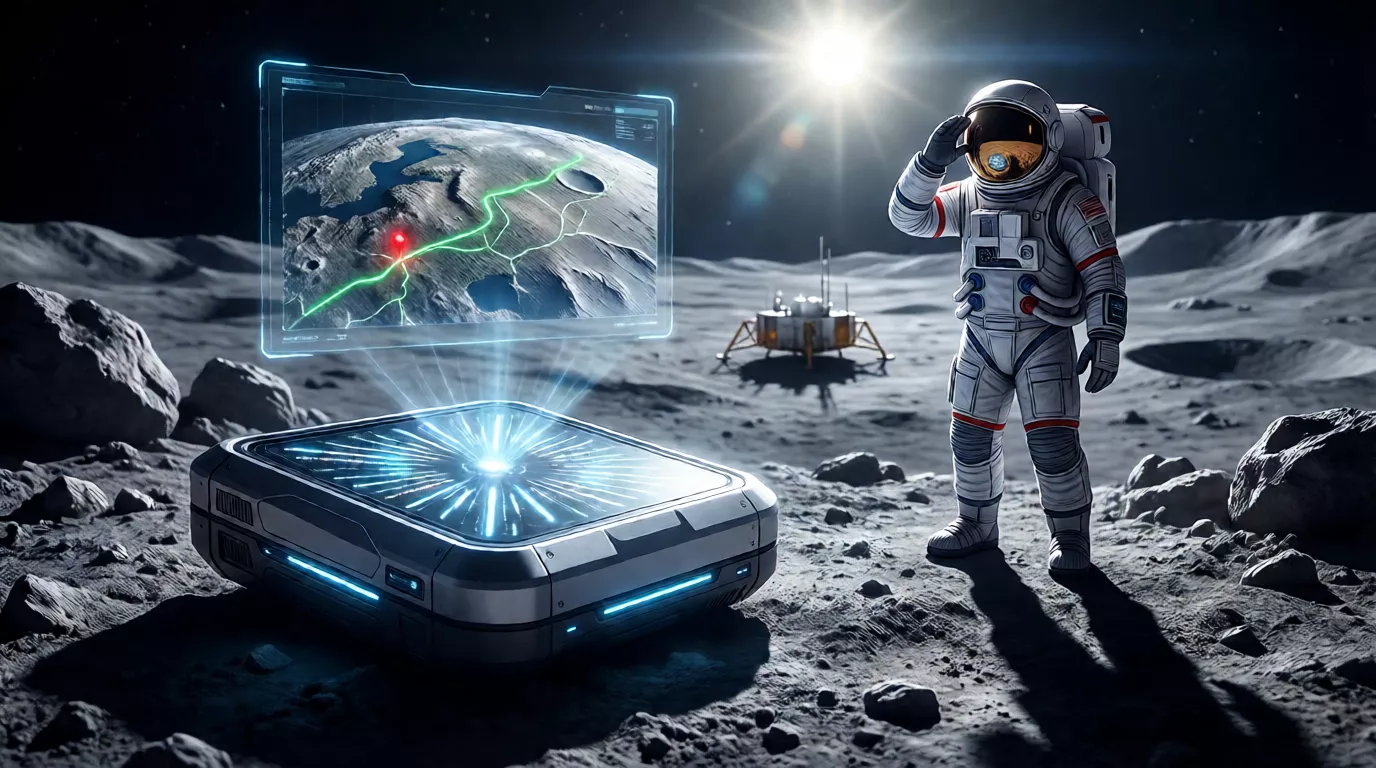
The first of these tools is a refined version of the sun compass used during the Apollo missions. Unlike a traditional magnetic compass—which is useless on the Moon due to the lack of a global magnetic field—the sun compass uses the position of the Sun and the shadow it casts. Mission Control in Houston will provide astronauts with the expected shadow angle for their location and time. By aligning their device’s shadow with that reference, astronauts can determine true lunar north and calculate bearings to landmarks or the lander. Designed for use with pressurized gloves and limited visibility, the tool features intuitive markings and built-in calibration steps for quick orientation.

The second tool employs a classic navigation technique: angular triangulation. Using a handheld sighting device, astronauts can take bearings to three known lunar features—such as crater rims or ridgelines—then plot those lines on a pre-marked map. Where the lines intersect reveals their current location. This method is especially valuable when surface tracks—whether from boots or rovers—become tangled and indistinguishable.
“After a few hours of exploration, the area around a landing site can look like a maze of overlapping paths,” says Robbie Gest, a technical lead at KBR. “Without clear visual cues, it’s easy to lose your sense of direction. These paper-based tools help crews reestablish their position quickly and confidently.”
NASA plans to test these analog navigation aids during the Artemis III mission, the first crewed lunar landing since Apollo. The long-term vision is to integrate the underlying principles into a digital system for later missions like Artemis V, offering real-time location tracking while preserving the simplicity and reliability of the manual backups.
“We’re building a bridge from low-tech to high-tech,” Anderson notes. “Starting with paper gives us a fail-safe baseline. As we refine the technology, we’ll layer in electronics—but never at the expense of redundancy. Crew safety and mission success depend on it.”
These navigation innovations do more than just prevent astronauts from getting lost. They empower explorers to venture farther from their lander, conduct more extensive scientific investigations, and respond effectively to unexpected situations—like a rover malfunction miles from base.
“If a rover breaks down, you can’t just call for a ride,” Anderson adds. “You need to know exactly which way to walk, and how far. That’s the kind of confidence these tools are designed to provide.”
From the pioneering days of Apollo to the ambitious scope of Artemis, lunar navigation has evolved—but the fundamentals remain. By combining time-tested techniques with modern engineering, KBR is helping ensure that the next generation of moonwalkers won’t just explore the lunar south pole; they’ll navigate it with precision, safety, and confidence.
Source link: https://www.kbr.com/